Powder Compacting Press
- Dry powder, compacted in the dieThe powder fills the die cavity and interlocks under pressure; the part comes out hard enough to be handled.
- Even density at every pointA difference in density changes shrinkage in the kiln locally; distortion and cracking arise from this.
- Staged pressure, ramped releaseTrapped air that is not vented raises blisters; if the pressure is released suddenly the green body cracks.
- The same principle, different automationSalt cores, zirconia blocks and glass mosaics are the same compaction; what changes is the die and the feeding.
What is a Powder Compacting Press?
A powder compacting press turns dry powder or a granulate blend into a handleable green part by compacting it in a die. Water-soluble salt cores, zirconia blocks and glass mosaics are pressed in the same class of machine; what changes is the die and the feeding automation.
If compaction density is not even at every point, the part distorts in the kiln. Powder preparation, granulation and firing are outside the press's scope. Sheet metal forming is not this press's job — there is no powder there; the material is made to flow into the die.
Is this press right for you?
Suitable
- Green parts for the kiln from dry powder or granulate blends
- Water-soluble salt cores — narrow internal channels that cannot be made with a sand core
- Zirconia blocks and CAD/CAM discs, technical ceramic green parts
- Glass mosaic tiles and similar small pressed ceramic work
- Series die cycling with robotic loading and unloading
- If your material is a blank rather than powder: Deep Drawing Press
- If you are pressing the casting itself rather than the core: Hydraulic Casting Press
- If you are moulding a resin–fibre blend: SMC & BMC Press
- If you are pressing tableware from melamine powder: Melamine Press
Automotive — parts typically produced in this sector
These images are representative — they show the shape of the part; they are not the exact parts we produce. If you find one that resembles your own part, send us its drawing and we will tell you which press it is made on. Send your part drawing
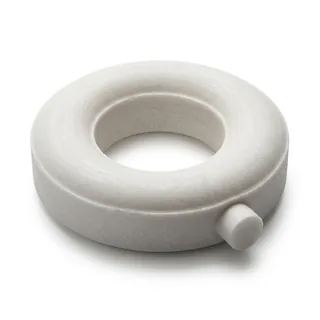 representative
Salt core for a piston cooling gallery  representative
Soluble salt core
Metalworking — parts typically produced in this sector
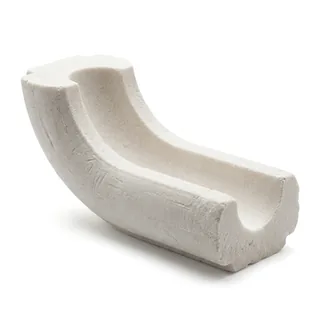 representative
Soluble salt core
Medical & Healthcare — parts typically produced in this sector
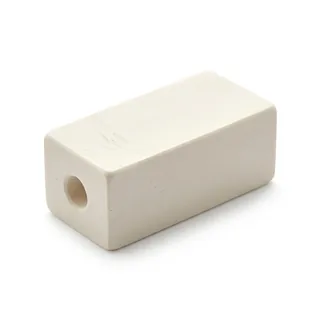 representative
Zirconia block 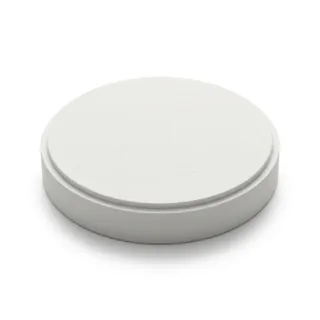 representative
Zirconia disc  representative
Technical ceramic component and green part
Construction & Building — parts typically produced in this sector
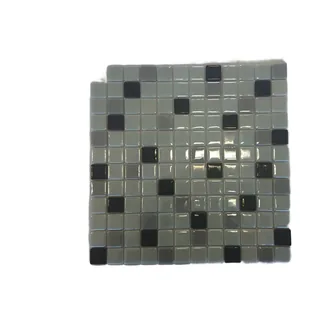
Glass mosaic tile  representative
Ceramic border and decorative moulding
This press at work
Tap the cover and the video opens on this page. Until you do, no request goes to YouTube.
POWDER COMPACTING HYDRAULIC PRESS
Hydraulic Glass Mosaic Press - Özkoç Hidrolik
For those who want the detail
How it works — and why they are all the same machine
Dry powder or a granulate blend fills the die cavity, the ram descends and compacts the powder with staged pressure. The grains interlock; the part leaving the die has not yet been fired but is dense enough to carry its own weight. Final hardness is given by the kiln; the kiln and powder preparation are outside the press's scope, and these steps have to be considered separately when the line is planned.
The whole job comes down to density distribution. If the powder is not at the same density at every point, shrinkage in the kiln varies locally and the part distorts; trapped air that is not vented raises blisters during firing; if pressure is removed suddenly the green body cracks. The pressing is therefore staged, the degassing stops are planned and the release is ramped. The pressure profile sits in the PLC recipe, and when the blend changes so does the recipe; even if the die throws its weight to one side, the ram must still descend parallel.
The salt core is this press's most instructive job. The core that forms the internal cavity of a casting is pressed from salt; once the casting has solidified the part is washed, the core dissolves in water and what is left behind is an internal channel too narrow to be obtained with a sand core. Piston cooling galleries are made this way. If density is not homogeneous across the core section the core breaks, and the fault shows up in the most expensive place — in the casting itself. Where the internal geometry is simple, on the other hand, a sand core is more economical — a salt core is not the right choice for every casting.
Zirconia blocks, CAD/CAM discs for dentistry, glass mosaic tiles, small ceramic borders — all of them are the same class of machine. What changes is the die and the feeding automation: one runs with robotic loading and unloading, another produces dozens of parts per cycle from a multi-cavity die. Opening a separate press category for every material name misleads the buyer; the machine is defined by the process, not by the material.
- Die filling → staged compaction → degassing stops → ramped release → green part
- The pressure profile is held in the PLC recipe; when the blend changes, the recipe changes
- A ram that descends parallel is the precondition for even density in a multi-cavity die
- It works integrated with an automatic loading and unloading robot; the operator does not touch the die
- Out of scope: powder preparation, granulation, glazing and the sintering kiln
Rigid frame joined with prepared weld bevels
When the form or the embossing does not come out, the toolmaker is blamed straight away. More often than not the die is not the cause: the press frame deflects under load and the two halves of the die no longer seat fully on each other. The share the frame has in this is usually unknown on the buyer's side, because it is written in no catalogue.
When ÖZKOÇ builds the frame as a welded construction, it joins the crossbeams and the plates BY PREPARING A WELD BEVEL. There are many companies in the sector that join without preparing a bevel; the weld then stays on the surface only. Once the bevel is prepared, the weld penetrates the cross-section and the frame resists deflection under load.
This holds for every frame type, monoblock or column-type — it is not an option that depends on the type of press, it is ÖZKOÇ's manufacturing discipline.
- Crossbeams and support plates are joined with a prepared weld bevel.
- The weld does not stay on the surface, it penetrates the cross-section; the frame does not deflect under load.
- The same discipline is applied whether the frame is monoblock or column-type.