Deep Drawing Press
- Adjustable speed and cushion forceTo keep wrinkling under control, the drawing speed and the counter-holding force are set to suit the part. As the sheet gains depth, material builds up at the edge; the blank holder restrains it and prevents wrinkling.
- Blank holder pressure is decisiveIf the pressure is too low the sheet wrinkles; if it is too high the flow is choked and the part tears; the window between the two is narrow.
- Seamless vessels and bodies, multi-stage drawing
What is a Deep Drawing Press?
A deep drawing press turns a flat sheet blank into a seamless vessel or body form by letting it flow into the die cavity. The material is not cut, it is drawn. As the depth approaches the diameter, the job cannot be finished in one go; the draw is split into stages.
What is decisive is not the tonnage but the control: if the blank holder pressure is too low the sheet wrinkles, if it is too high the flow is choked and the part tears. Shallow forming and bending are not this press’s work. ÖZKOÇ moved into deep drawing presses at the end of the 1970s and, as the cookware sector grew, took them into series production in the early 1980s.
Is this press right for you?
Suitable
- Sheet metal forms whose edge is at risk of wrinkling
- Deep parts where the draw has to be split into stages
- Work that calls for a seamless, weld-free one-piece body
- If edge trimming or flange trimming is involved: Hydraulic Cutting Press
- If the volume is high and the job can be split between stations: Hydraulic Transfer Press
Cookware — parts typically produced in this sector
These images are representative — they show the shape of the part; they are not the exact parts we produce. If you find one that resembles your own part, send us its drawing and we will tell you which press it is made on. Send your part drawing
 representative
Sink bowl 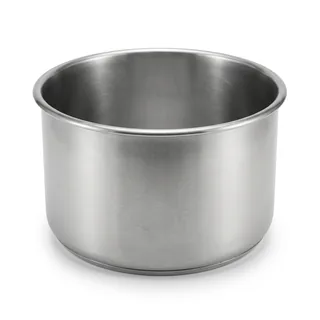 representative
Pot and cauldron body 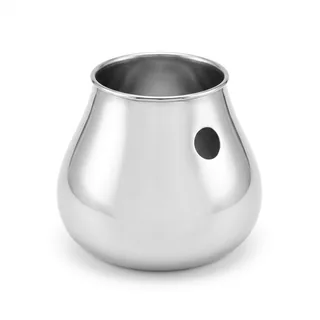 representative
Teapot body  representative
Stainless steel rectangular container and lid
Automotive — parts typically produced in this sector
 representative
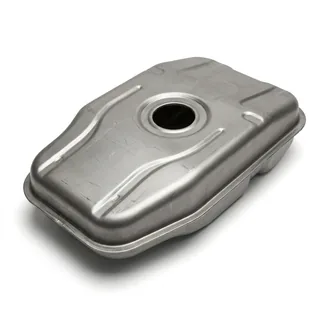
Fuel tank half-shell 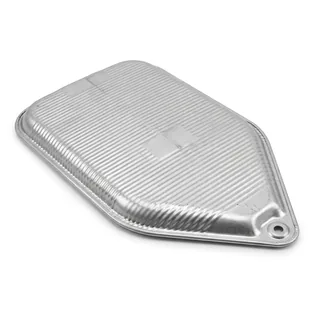 representative
Exhaust heat shield 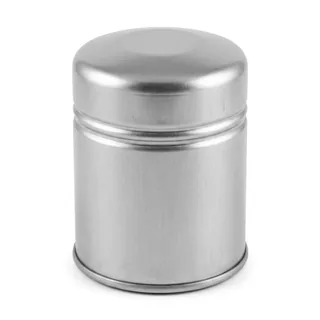 representative
Oil filter housing 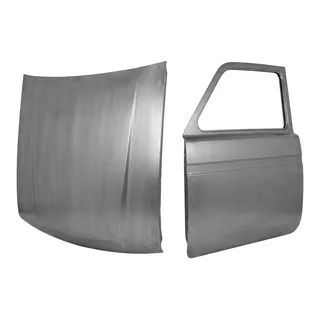 representative
Bonnet and side door 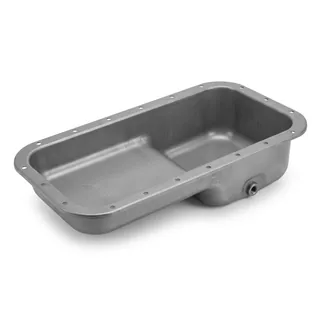 representative
Engine oil sump 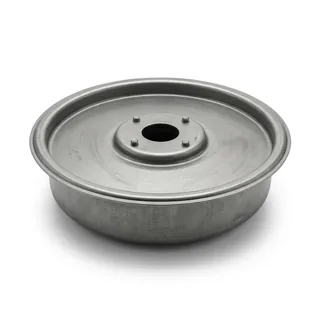 representative
Brake chamber body  representative
Truck air-spring bellows body
Defence Industry — parts typically produced in this sector
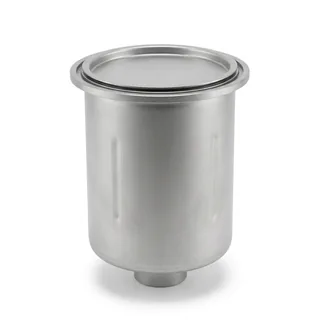 representative
Cylindrical protective housing
Medical & Healthcare — parts typically produced in this sector
 representative
Stainless steel rectangular container and lid
Metalworking — parts typically produced in this sector
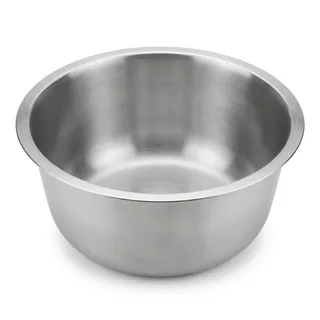 representative
Deep-drawn open vessel body  representative
Multi-stage drawing sequence 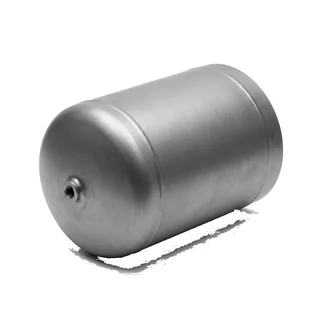 representative
Compressor tank body  representative
Tank dished end 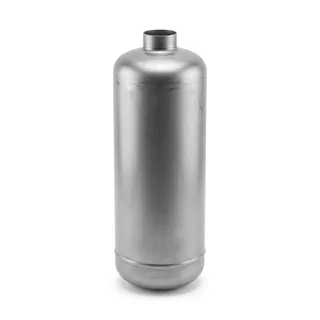 representative
Fire extinguisher body
Construction & Building — parts typically produced in this sector
 representative
Airport and façade sheet metal cladding panel
This press at work
Tap the cover and the video opens on this page. Until you do, no request goes to YouTube.
Fire Extinguisher Deep Drawing
Özkoç - High-Speed Hydraulic Deep Drawing Press
Wheelbarrow production - Özkoç 400 Tonne Monoblock Hydraulic Deep Drawing Press with Easy Die Loading System
Özkoç - Automatic High-Speed Deep Drawing Press - Automatic Teflon pan manufacture
Filter housing production - Özkoç Hidrolik triple-action double drawing press
DOME PRODUCTION SYSTEM - TESY BULGARIA
Stainless Steel Sink Production - Özkoç Hidrolik Makina
For those who want the detail
How a conventional deep drawing press works
In the conventional type the upper side is the active one: the main cylinder drives the upper die down and the lower side holds against it. The counter-holding force comes from the cushion cylinder beneath the bolster and is carried to the underside of the blank holder in the die by the cushion pins supported on the cushion plate. The sheet is thus held between two surfaces at a measured pressure; it does not wrinkle as it flows through the die opening.
To say “the force is constant throughout the stroke” is not correct. As the resistance of the material being formed changes, so does the force; the cushion force too varies with the flow resistance of the sheet. The advantage of the hydraulic press over the eccentric one is not constancy but control: the nominal force can be obtained at any desired point of the stroke — on an eccentric press full tonnage is reached only close to bottom dead centre — the speed is profiled to suit the part, the stroke can be stopped wherever wanted, and the blank holder force is set independently of the drawing force.
The result is determined as much by the die, the quality of the sheet, the lubrication and, where needed, intermediate annealing as by the press; the press alone does not make up for these. As the depth approaches the diameter the draw is split into stages, and between the stages the work-hardened sheet is softened again. ÖZKOÇ carries out the frame, the hydraulics, the electrics and the PLC/HMI software under one roof, from design through to commissioning; the drawing recipe is stored in the machine’s control.
- The upper side is active: the main cylinder drives the die.
- The lower side holds against it: the cushion plate feeds the blank holder through the cushion pins.
- Blank holder pressure too low → the sheet wrinkles; too high → the part tears.
- The force is not constant; it changes with the resistance of the material and is controlled.
- As the depth approaches the diameter the draw is split into stages, and annealing may be needed in between.
A rigid frame joined with prepared weld bevels
When the form and the embossing do not come out, the toolmaker is blamed at once. More often than not the die is not the cause: the press frame deflects under load and the die halves do not seat properly on one another. The frame’s share in this is usually unknown to the buyer, because it is written in no catalogue.
When ÖZKOÇ builds the frame as a welded construction, it joins the crossbeams and the plates BY PREPARING A WELD BEVEL. There are many firms in the industry that join without preparing a bevel; the seam then stays on the surface only. With the bevel prepared, the seam works into the section and the frame resists deflection under load.
This holds for every frame type, monoblock or column-type — it is not an option that depends on the type of press, it is ÖZKOÇ’s manufacturing discipline.
- The crossbeams and the supporting plates are joined with a prepared weld bevel.
- The seam does not stay on the surface, it works into the section; the frame does not deflect under load.
- The same discipline is applied whether the frame is monoblock or column-type.