Brake Lining Curing Press
- Degassing cycleGas forms during curing; if it is not vented the part blisters and the friction surface stays porous.
- Zoned mould heatingA temperature difference across the mould shifts the friction coefficient from part to part.
- Top-acting, bottom-acting and multi-daylight frame arrangements
What is a Brake Lining Curing Press?
The brake lining curing press cures the friction compound of a brake lining — resin, fibre, filler — under pressure in a heated mould. Mould temperature, dwell time under pressure and the degassing steps determine the density of the part and the stability of its friction coefficient.
Gas forms in the resin during curing; if this gas is not vented the part blisters and the friction surface stays porous.
Is this press right for you?
Suitable
- Curing a friction compound of resin, fibre and filler in a mould
- Disc and drum brake linings, industrial friction elements
- Phenolic and Bakelite-based compounds that require degassing
- Holding the same friction coefficient across a multi-cavity mould
- If your compound is rubber-based: Rubber Curing Press
- If you will press fibre-reinforced structural plate: Composite Press
Automotive — parts typically produced in this sector
These images are representative — they show the shape of the part; they are not the exact parts we produce. If you find one that resembles your own part, send us its drawing and we will tell you which press it is made on. Send your part drawing
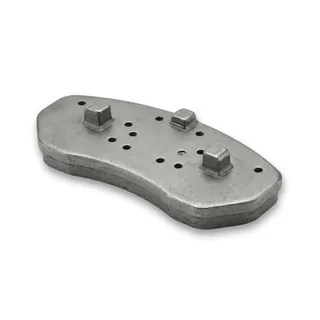 representative
Disc pad and drum brake lining 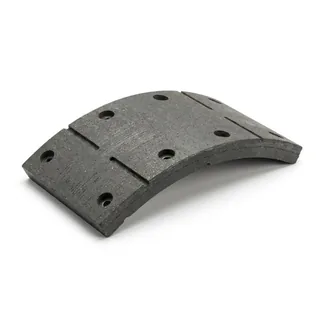 representative
Heavy-duty friction element
Construction & Building — parts typically produced in this sector
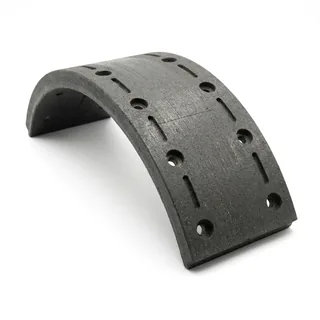 representative
Heavy-duty friction element
For those who want the detail
What decides the job on a brake lining press: heat, time and letting the gas out
A brake lining is not a part formed like sheet metal but a compound cured inside a mould. The compound of resin, fibre and filler is charged into the mould, held under pressure between heated platens, and the resin hardens to build the bond structure that holds the part together.
Gas forms in the resin during curing. If this gas is not taken out of the mould the part blisters from the inside, the friction surface stays porous and the lining fails to reach the friction coefficient expected of it in the brake. Degassing (breathing) steps — the ram breathing at short intervals — are therefore part of the recipe, not decoration.
The friction coefficient coming out the same from part to part depends on the temperature at the mould face being the same at every point. Zoned heating and thermocouple feedback hold the mould at a single temperature; in multi-cavity moulds the rigidity of the frame ensures that every cavity receives the same pressure.
ÖZKOÇ does not build brake lining presses as a single type: top-acting, bottom-acting and multi-daylight arrangements are chosen according to the mould structure of the job. The same frame family is also used for other hot press work such as rubber and melamine; what changes is the mould, the number of heating zones and the recipe.
- Heated platens with zone-by-zone thermocouple control
- Degassing (breathing) steps defined in the recipe
- Closing speed and dwell time under pressure are set separately
- Top-acting, bottom-acting and multi-daylight frame arrangements
- Recording of cure temperature and cycle data (optional)
Rigid frame joined with prepared weld bevels
When the form or the embossing does not come out, the toolmaker is blamed straight away. More often than not the die is not the cause: the press frame deflects under load and the two halves of the die no longer seat fully on each other. The share the frame has in this is usually unknown on the buyer's side, because it is written in no catalogue.
When ÖZKOÇ builds the frame as a welded construction, it joins the crossbeams and the plates BY PREPARING A WELD BEVEL. There are many companies in the sector that join without preparing a bevel; the weld then stays on the surface only. Once the bevel is prepared, the weld penetrates the cross-section and the frame resists deflection under load.
This holds for every frame type, monoblock or column-type — it is not an option that depends on the type of press, it is ÖZKOÇ's manufacturing discipline.
- Crossbeams and support plates are joined with a prepared weld bevel.
- The weld does not stay on the surface, it penetrates the cross-section; the frame does not deflect under load.
- The same discipline is applied whether the frame is monoblock or column-type.
Ram parallelism system
On wide and asymmetric parts the load bears on one corner of the ram; the ram comes down slightly tilted and one corner of the part turns out thicker than the other. The result: excess material, uneven strength, unnecessary heat and cycle time.
In the ram parallelism system designed by ÖZKOÇ itself, four counter-pressure cylinders bring the ram down parallel to the lower plate. The difference in thickness between the corners drops to a minimum; material is saved, and the homogeneity of the part keeps the strength where it is wanted.
The same arrangement works in cutting as well: at the instant the shear occurs, the counter-pressure cylinders absorb the shock, maintain parallelism and extend the life of the cutting die.
- Four counter-pressure cylinders bring the ram down parallel to the lower plate.
- On a wide and asymmetric part the difference in thickness between the corners drops to a minimum.
- Material savings + homogeneous strength.
- In cutting it absorbs the shock and extends die life.