Coining Press
- Work hardening through cold coiningThe grain structure is compacted and the yield strength rises; the part comes out stronger.
- A rigid frame at high tonnageA frame that deflects loses the dimension and wears the die.
- Shock-free force transitionsApproach, coining and decompression pass smoothly through a proportional valve; there is no impact.
What is a Coining Press?
A coining press shapes a metal part by compressing it with high force in a die at room temperature. Cold coining work hardens the material: the grain structure is compacted, the yield strength rises and the part reaches its final dimension without any metal being removed. By its nature the process demands high tonnage.
It does not draw sheet metal into deep vessels and it does not cast molten metal; its job is to bring a solid part to dimension and surface by compressing it.
Is this press right for you?
Suitable
- Bringing a solid part to its final dimension by cold coining
- Chipless sizing and work hardening
- Surface patterning and mark impressing
- If your part will be deep drawn from sheet metal: Deep Drawing Press
- For shallow forming and embossing work: Hydraulic Forming Press
- If your part will be produced from molten aluminium: Hydraulic Casting Press
Cookware — parts typically produced in this sector
These images are representative — they show the shape of the part; they are not the exact parts we produce. If you find one that resembles your own part, send us its drawing and we will tell you which press it is made on. Send your part drawing
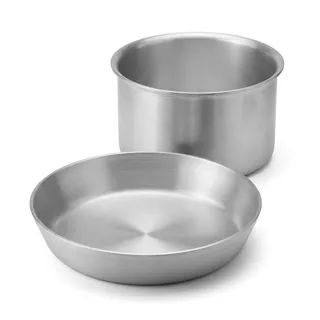 representative
Aluminium pan and pot
Metalworking — parts typically produced in this sector
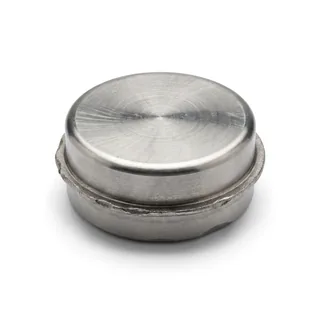 representative
Cold coining of a solid steel part  representative
Surface patterning and mark impressing
This press at work
Tap the cover and the video opens on this page. Until you do, no request goes to YouTube.
3000 Tonne Hydraulic Coining Press
Rebar coining press
For those who want the detail
How it works — and why tonnage alone is not enough
The part is placed in the die, the ram descends and compresses the material at room temperature. The material flows, fills the die cavity and takes on the die surface. There is no heating; dimensions are therefore consistent and there is no scale and no distortion, but the force required is far above that of a hot process.
The real gain from cold coining is not the dimension but the material: the grain structure is compacted, the yield strength rises and the surface hardens. Had the same part been machined, the grain flow would have been cut through and material would have been lost as swarf. In coining there is no loss, only material that has moved.
Tonnage on its own is not a sufficient promise. If the frame deflects under high force, the parallelism between ram and bolster is lost; the part is coined more on one side, the dimension drifts and the die wears on one side. That is why what is decisive in this class is not the tonnage figure but how much the frame deflects at that tonnage.
The force transitions must also be free of shock. The approach is fast, the coining slow and controlled, and the decompression staged; a proportional valve smooths these transitions. A sudden release hammers both the die and the machine. With high-alloy materials it is often not possible to reach the shape in a single stage — the number of stages is calculated from the part and the material.
- Cold process: no scale, no distortion, consistent dimensions
- Work hardening: the grain structure is compacted, yield strength and surface hardness increase
- No material lost as swarf — the material is not cut, it is displaced
- What is decisive is not tonnage but frame deflection and ram parallelism at that tonnage
- Approach / coining / decompression are managed shock-free by a proportional valve
- With high-alloy materials the number of stages is calculated from the part
Rigid frame joined with prepared weld bevels
When the form or the embossing does not come out, the toolmaker is blamed straight away. More often than not the die is not the cause: the press frame deflects under load and the two halves of the die no longer seat fully on each other. The share the frame has in this is usually unknown on the buyer's side, because it is written in no catalogue.
When ÖZKOÇ builds the frame as a welded construction, it joins the crossbeams and the plates BY PREPARING A WELD BEVEL. There are many companies in the sector that join without preparing a bevel; the weld then stays on the surface only. Once the bevel is prepared, the weld penetrates the cross-section and the frame resists deflection under load.
This holds for every frame type, monoblock or column-type — it is not an option that depends on the type of press, it is ÖZKOÇ's manufacturing discipline.
- Crossbeams and support plates are joined with a prepared weld bevel.
- The weld does not stay on the surface, it penetrates the cross-section; the frame does not deflect under load.
- The same discipline is applied whether the frame is monoblock or column-type.