Hydroforming Press (T-Fitting Press)
- Tube in, T outIt does not join separate parts; it produces the finished fitting from a single tube in a single cycle.
- Weld-free, seamless fittingA weld seam is the weak point for both sealing and fatigue; here there is no joint at all.
- Axial feeding under matched controlInternal pressure and end feeding are set together; wall thinning stays under control.
- Short cycle timeAgainst cheap equivalents, the purchasing decision is made by output per hour.
What is a Hydroforming Press (T-Fitting Press)?
A hydroforming press applies high-pressure fluid inside a tube held in a closed die and makes the material flow into the die form. In the T-fitting application a tube goes in and a one-piece T comes out: axial cylinders feed the tube from its ends while internal pressure fills the side cavity. There is no weld seam.
In a welded T the joint is the weak point for sealing and fatigue. Vessel geometries drawn from sheet metal, on the other hand, are not this press's job; for fittings of simple geometry in very high volumes, forging may be more economical. ÖZKOÇ is among the hydroforming press manufacturers that build the complete machine in their own plant: design, welded frame, machining and hydraulic assembly all take place in İstanbul.
Is this press right for you?
Suitable
- Seamless T and branch fittings from tube
- Thin-walled hollow tubular parts
- Fittings where a weld seam carries a sealing or fatigue risk
- If your part will be deep drawn from sheet metal: Deep Drawing Press
- For shallow forming and embossing work: Hydraulic Forming Press
Construction & Building — parts typically produced in this sector
These parts are genuine samples pressed on ÖZKOÇ presses. If you find one that resembles your own part, send us its drawing and we will tell you which press it is made on. Send your part drawing

Seamless pipe tee and elbow fitting
Metalworking — parts typically produced in this sector
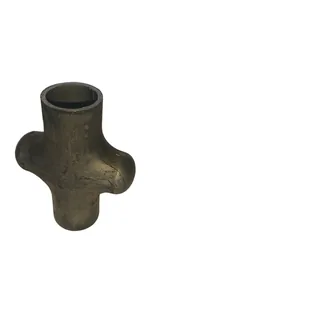
Seamless pipe tee and elbow fitting
This press at work
Tap the cover and the video opens on this page. Until you do, no request goes to YouTube.
Özkoç Hydraulic T-Fitting Press
For those who want the detail
How it works — and why cycle time is the talking point on this press
A cut length of tube is placed in the die and the die closes. The inside of the tube is filled with fluid and pressurised. At the same time two axial cylinders push the tube from its ends and feed material. The internal pressure bulges the material out into the side cavity, while the axial feeding supplies the material that goes into that bulging area.
The whole subtlety of the job lies in managing these two forces simultaneously. If pressure runs high relative to feeding, the branch area thins and bursts; if feeding runs high relative to pressure, the tube buckles and wrinkles. With the right recipe the part comes out in a single cycle, free of flash and free of welds. The recipe is specific to the part: when tube diameter, wall thickness or material grade changes, the pressure–feed curve is set up again.
The comparison with welded production is simple: in a welded T the joint is the weakest point of the line for both sealing and fatigue, and welding, cleaning and testing each demand a separate station. In hydroforming the fitting is a single piece; there are no intermediate stations.
There are cheap imported equivalents in this class, and the purchasing decision is usually made not by price but by output per hour: as cycle time falls, cost per part falls with it. Özkoç builds this press around speed — the cycle time figure will be published on this page, and at the quotation stage it is given according to part geometry.
- The tube goes into the die, the die closes, the internal volume is pressurised with fluid
- Axial cylinders feed from the ends; internal pressure bulges out the branch
- The balance of pressure and feeding: too much pressure tears, too much feeding buckles
- The output is a single weld-free piece — no separate welding, cleaning or leak test station
- The benchmark is cycle time: output per hour determines cost per part
Rigid frame joined with prepared weld bevels
When the form or the embossing does not come out, the toolmaker is blamed straight away. More often than not the die is not the cause: the press frame deflects under load and the two halves of the die no longer seat fully on each other. The share the frame has in this is usually unknown on the buyer's side, because it is written in no catalogue.
When ÖZKOÇ builds the frame as a welded construction, it joins the crossbeams and the plates BY PREPARING A WELD BEVEL. There are many companies in the sector that join without preparing a bevel; the weld then stays on the surface only. Once the bevel is prepared, the weld penetrates the cross-section and the frame resists deflection under load.
This holds for every frame type, monoblock or column-type — it is not an option that depends on the type of press, it is ÖZKOÇ's manufacturing discipline.
- Crossbeams and support plates are joined with a prepared weld bevel.
- The weld does not stay on the surface, it penetrates the cross-section; the frame does not deflect under load.
- The same discipline is applied whether the frame is monoblock or column-type.