Hydraulic Casting Press
- It works with an open mouldNo air bubbles are trapped inside the aluminium.
- Half the tonnage of die castingThere is no need to push molten metal through narrow channels; mould cost and floor space also come down by half.
- Around 1% scrap rateThe scrap rate for the same job in die casting is in the tens of per cent.
- A design developed by Özkoç itself
What is a Hydraulic Casting Press?
A casting press pours molten aluminium into an open mould and shapes it with press force. For parts of suitable geometry it is the alternative to an aluminium die casting machine: a simpler mould, less tonnage and less floor space. It is a press developed by Özkoç itself.
It is not a machine that trims the flash or the runner off a finished casting; it produces the part directly from liquid metal. Nor does it form sheet metal — sheet work belongs to deep drawing and forming presses.
Is this press right for you?
Suitable
- Producing parts directly from molten aluminium
- Aluminium bodies to be Teflon-coated or painted afterwards
- Geometries that suit an open mould — kitchen utensils, handles, bodies
- If you will trim the flash or the runner off a casting: Hydraulic Cutting Press
- If your part will be drawn from sheet metal: Deep Drawing Press
- For shallow forming and embossing work: Hydraulic Forming Press
Cookware — parts typically produced in this sector
These parts are genuine samples pressed on ÖZKOÇ presses. If you find one that resembles your own part, send us its drawing and we will tell you which press it is made on. Send your part drawing
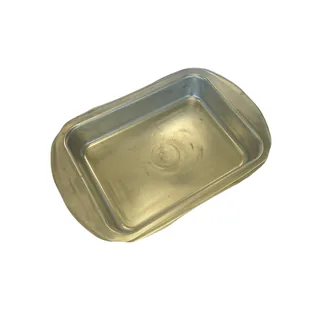
Aluminium cast body pressed in an open mould
Metalworking — parts typically produced in this sector
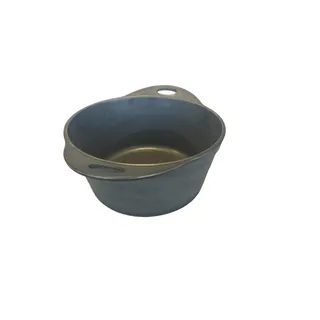
Aluminium cast body pressed in an open mould
For those who want the detail
How it works — and why this instead of die casting?
Molten aluminium is placed into the open mould. The press descends and spreads the metal into the mould cavity. The mould is not a closed cavity; the metal is not forced through narrow channels but spreads under gravity and press force. The whole character of the press follows from this single difference.
The classic route for the same part is an aluminium die casting machine. Cem Bey's comparison runs as follows: the die casting machine demands twice the tonnage for this job, takes up far more floor area, its mould costs twice as much as this one and its price is twice as high as well. The reason for the extra tonnage is mechanical — pushing molten metal through very narrow channels is an energy item in its own right.
The second item is the runner. In die casting the aluminium that solidifies in the channels has to be cut away from the product itself and then melted down again. That aluminium is recovered, but the melting energy spent on it is not.
On the quality side the difference is even clearer. While the scrap rate in die casting is in the tens of per cent, on this press it stays at around one per cent. The reason is again the open mould: no air bubbles are trapped inside the aluminium. With no air bubbles left, the paint or Teflon coating applied afterwards is not spoiled either — and that is exactly what is decisive for coated cookware.
For parts of suitable geometry this machine is the alternative to an aluminium die casting machine. It is a design developed entirely by Özkoç and puts ease of operation first.
- Open mould: the metal is not forced through narrow channels and no air bubbles are trapped
- Half the tonnage and half the mould cost of die casting, with a smaller footprint
- Scrap rate: tens of per cent in die casting, around one per cent on this press
- No runner — no surplus aluminium to be cut away and melted down again
- Coating compatibility: a bubble-free surface does not spoil paint or Teflon
Rigid frame joined with prepared weld bevels
When the form or the embossing does not come out, the toolmaker is blamed straight away. More often than not the die is not the cause: the press frame deflects under load and the two halves of the die no longer seat fully on each other. The share the frame has in this is usually unknown on the buyer's side, because it is written in no catalogue.
When ÖZKOÇ builds the frame as a welded construction, it joins the crossbeams and the plates BY PREPARING A WELD BEVEL. There are many companies in the sector that join without preparing a bevel; the weld then stays on the surface only. Once the bevel is prepared, the weld penetrates the cross-section and the frame resists deflection under load.
This holds for every frame type, monoblock or column-type — it is not an option that depends on the type of press, it is ÖZKOÇ's manufacturing discipline.
- Crossbeams and support plates are joined with a prepared weld bevel.
- The weld does not stay on the surface, it penetrates the cross-section; the frame does not deflect under load.
- The same discipline is applied whether the frame is monoblock or column-type.