Hydraulic Forming Press
- Single-acting · no blank holderThere is no counter-holding; the form is not deep and there is little or no wrinkling — a blank holder is not needed.
- Shallow forming, bending, embossing, coiningAs long as the depth of the shape stays shallow the job is finished with a single action and no cushion setting is required.
- A frame that does not deflect is decisiveIf the frame deflects the embossing does not come out fully, and the die gets the blame.
- Standard sizes and tonnages
What is a Hydraulic Forming Press?
A forming press shapes sheet and metal parts inside a die with a single action: bending, embossing, forming, coining. There is no counter-holding force; because the form is shallow the sheet does not wrinkle at the edge and no blank holder is needed.
Nominal force is obtained at any desired point of the stroke; speed and stopping point are set to suit the job. Let us state the limit as well: deep drawing that calls for a blank holder is not this press's job — that part goes to a deep drawing press.
Is this press right for you?
Suitable
- Shallow forming, embossing, bending and coining work
- Straightening and sizing
- Embossed surfaces expected to reproduce the die exactly
- Parts with no wrinkling risk that need no counter-holding force
- If your part is deep or its edge wrinkles: Deep Drawing Press
- If edge cutting and flange trimming are needed: Hydraulic Cutting Press
- If you will cold coin a solid part: Coining Press
Cookware — parts typically produced in this sector
These images are representative — they show the shape of the part; they are not the exact parts we produce. If you find one that resembles your own part, send us its drawing and we will tell you which press it is made on. Send your part drawing
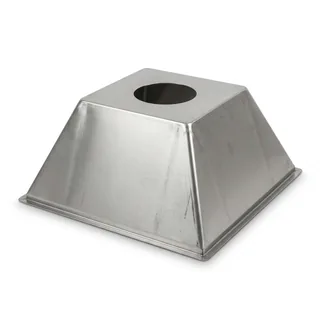 representative
Cooker hood body
Automotive — parts typically produced in this sector
 representative
Stage 1 — deep drawingThe sheet gains depth; the radii are wide and the surface is flat. There is no embossing or piercing yet. 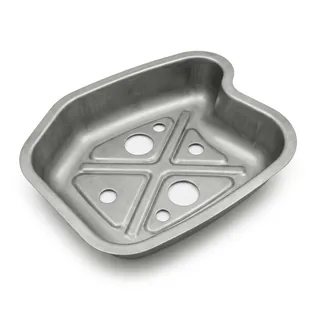 representative
Stage 2 — forming pressThe same part is finished on the forming press: the radii are set, and the stiffening channels and mounting openings are formed. Inner panel form The same part is finished on two presses — see the sequence.
Metalworking — parts typically produced in this sector
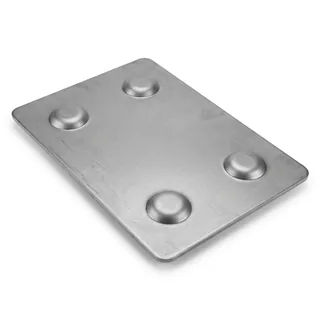 representative
Part formed and sized in a spring-loaded die 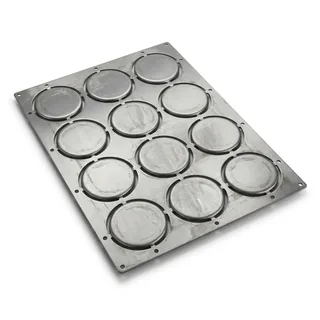 representative
Part array from a multi-cavity die  representative
Badge and emblem embossing
This press at work
Tap the cover and the video opens on this page. Until you do, no request goes to YouTube.
Hydraulic Forming Press & OZKOC
FULLY AUTOMATIC DISC LOADING AND UNLOADING HYDRAULIC FORMING PRESS
For those who want the detail
On a forming press what is decisive is not tonnage but a frame that does not deflect
On a forming press the work comes from above and finishes in a single action: the sheet is pressed onto the die surface and bending and embossing are completed in the same stroke. Because there is no counter-holding force, there is no blank holder, no cushion cylinder and no pin arrangement. The machine is simpler, the cycle is shorter and the die is simpler — but that simplicity only pays as long as the form stays shallow.
The real determinant is the frame. In forming, embossed features often fail to come out fully and the owner immediately blames the toolmaker. Yet the die is right; it is the press that deflects. When the frame opens up under load, the upper and lower die faces lose their parallelism and one end of the embossing fills while the other stays empty. This is why the importance of the frame is so often unknown to buyers — the press's tonnage is asked about, its rigidity is not.
ÖZKOÇ produces the frame as a welded steel construction and prepares a weld bevel where the crossbeams are joined to the plates. Frames joined without any weld bevel are very common in the industry; the difference shows not on the first day but when you change the die and go up to full tonnage. Special jobs requiring a die core, a loader or an ejector are engineered separately; at that point the machine is no longer a standard forming press.
- One cylinder, single action — no blank holder and no cushion arrangement.
- If the embossing does not come out, look first at frame deflection, not at the die.
- When the frame opens up, die parallelism is lost; the embossing fills at one end and falls short at the other.
- Jobs requiring a die core, a loader or an ejector are engineered separately.
Rigid frame joined with prepared weld bevels
When the form or the embossing does not come out, the toolmaker is blamed straight away. More often than not the die is not the cause: the press frame deflects under load and the two halves of the die no longer seat fully on each other. The share the frame has in this is usually unknown on the buyer's side, because it is written in no catalogue.
When ÖZKOÇ builds the frame as a welded construction, it joins the crossbeams and the plates BY PREPARING A WELD BEVEL. There are many companies in the sector that join without preparing a bevel; the weld then stays on the surface only. Once the bevel is prepared, the weld penetrates the cross-section and the frame resists deflection under load.
This holds for every frame type, monoblock or column-type — it is not an option that depends on the type of press, it is ÖZKOÇ's manufacturing discipline.
- Crossbeams and support plates are joined with a prepared weld bevel.
- The weld does not stay on the surface, it penetrates the cross-section; the frame does not deflect under load.
- The same discipline is applied whether the frame is monoblock or column-type.