Composite Press
- Composite is a broad headingKevlar, glass and carbon fibre, ballistic composite and newer materials such as PEEK all sit under the same roof.
- Heating and cooling togetherHot oil, electric heating, water or air cooling; the cycle is built around the material's recipe.
- Fibre orientation is preservedThe semi-finished material does not flow in the mould but consolidates where it lies; the calculated strength stays in the part.
- A pressure–temperature–time cycle managed by recipe
What is a Composite Press?
The composite press consolidates fibre-reinforced semi-finished materials — prepreg, organosheet, ballistic composite and technical materials such as PEEK — under pressure in a heated mould. What is decisive is holding pressure, temperature and time together.
Its difference is built on the heating–cooling side: every variety of hot oil, electric resistance, water- or air-cooled cycle. Do not confuse it with the SMC & BMC press, which makes chopped-fibre compound flow in the mould; here the semi-finished material does not flow and fibre orientation is preserved.
Is this press right for you?
Suitable
- Consolidation of prepreg, organosheet and thermoplastic composites
- Taking newer materials such as Kevlar, carbon and PEEK into series production
- Work where heating and cooling have to be managed within the same cycle
- If you will press chopped-fibre thermoset compound: SMC & BMC Press
- For recipe and specimen trials: Laboratory Press
- For ballistic protection plates and helmets: Ballistic Plate and Helmet Press
Automotive — parts typically produced in this sector
These images are representative — they show the shape of the part; they are not the exact parts we produce. If you find one that resembles your own part, send us its drawing and we will tell you which press it is made on. Send your part drawing
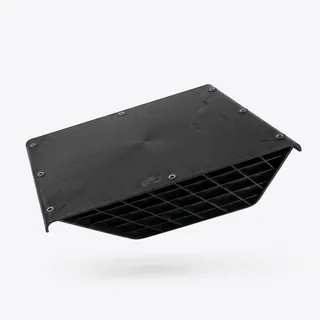 representative
Ribbed composite structural panel  representative
Battery housing  representative
Composite body panel
Defence Industry — parts typically produced in this sector
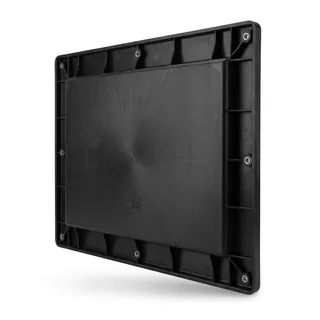 representative
Ribbed composite structural panel 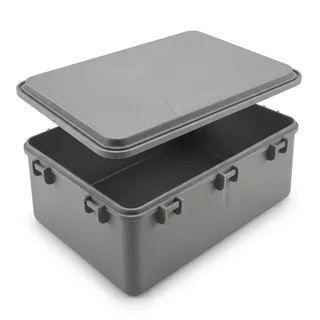 representative
Composite housing box and lid
This press at work
Tap the cover and the video opens on this page. Until you do, no request goes to YouTube.
Özkoç - Hydraulic Composite Press
ÖZKOÇ Composite press for ballistic applications
For those who want the detail
How it works: consolidation and heating–cooling engineering
Composite is not a single material but a heading. Kevlar, glass and carbon fibre, ballistic composite, technical thermoplastics such as PEEK and the new formulations that appear every year at the JEC show in Paris — all of them come under this heading. The press is therefore built not around a single material but around the cycle range it will work in.
The work being done is thermal, not mechanical: the resin becomes fluid, the air trapped between the layers is driven out, the section is compacted, and the part consolidates or cures. If platen parallelism drifts, section thickness varies locally; if degassing is insufficient, voids are left between the layers.
ÖZKOÇ's real accumulated experience here lies on the heating and cooling side. In most jobs the heating system also includes the cooling system, and the right cycle varies from material to material. ÖZKOÇ has built every variety of these systems; a customer arriving with a new recipe does not have to search from scratch for the heating–cooling combination that works.
With a new material the way is usually opened with a small batch: specimen and recipe trials are run on a laboratory press, and once the cycle has settled the same curve is carried over to the series production press. This is why a composite press is not a single machine but a family of cycles.
This accumulated experience is ÖZKOÇ's real difference against cheap alternatives that compare presses on price alone: what is bought is not a press but a cycle that answers the material's recipe.
- Mould heating with hot oil
- Heating with electric resistance elements
- Controlled cooling with a water circuit
- Air cooling
- Heating and cooling managed together within the same cycle
Rigid frame joined with prepared weld bevels
When the form or the embossing does not come out, the toolmaker is blamed straight away. More often than not the die is not the cause: the press frame deflects under load and the two halves of the die no longer seat fully on each other. The share the frame has in this is usually unknown on the buyer's side, because it is written in no catalogue.
When ÖZKOÇ builds the frame as a welded construction, it joins the crossbeams and the plates BY PREPARING A WELD BEVEL. There are many companies in the sector that join without preparing a bevel; the weld then stays on the surface only. Once the bevel is prepared, the weld penetrates the cross-section and the frame resists deflection under load.
This holds for every frame type, monoblock or column-type — it is not an option that depends on the type of press, it is ÖZKOÇ's manufacturing discipline.
- Crossbeams and support plates are joined with a prepared weld bevel.
- The weld does not stay on the surface, it penetrates the cross-section; the frame does not deflect under load.
- The same discipline is applied whether the frame is monoblock or column-type.
Ram parallelism system
On wide and asymmetric parts the load bears on one corner of the ram; the ram comes down slightly tilted and one corner of the part turns out thicker than the other. The result: excess material, uneven strength, unnecessary heat and cycle time.
In the ram parallelism system designed by ÖZKOÇ itself, four counter-pressure cylinders bring the ram down parallel to the lower plate. The difference in thickness between the corners drops to a minimum; material is saved, and the homogeneity of the part keeps the strength where it is wanted.
The same arrangement works in cutting as well: at the instant the shear occurs, the counter-pressure cylinders absorb the shock, maintain parallelism and extend the life of the cutting die.
- Four counter-pressure cylinders bring the ram down parallel to the lower plate.
- On a wide and asymmetric part the difference in thickness between the corners drops to a minimum.
- Material savings + homogeneous strength.
- In cutting it absorbs the shock and extends die life.